Sunday the 23rd of August 2026 - The Twenty-first Sunday in Ordinary Time
Isaiah 22:15, 19-23/ Ps 138(137/ Romans 11:33-36/ Matthew 16:13-20
In the gospel today Jesus asked His disciples who they say that he is. There are suggestions that people think he is John the Baptist, or Elijah, or one of the prophets. It is Simon, inspired by God, who speaks up and says, 'You are the Christ, the Son of the living God.' In reaction to this Jesus does not simply congratulate Simon for his answer, He gives him a new name, Peter, which means rock. It is on this rock that Jesus said He would build His Church. That one exchange, one confession of faith, is the foundation stone of everything we are as Catholics. The consequences of that conversation ripple down the ages all the way to us here today. The readings for today are brief, but we must not mistake brevity for simplicity. In just a few short verses, they cut to the heart of two truths: the total authority God holds over all creation, and the remarkable authority that Jesus entrusted to one man.
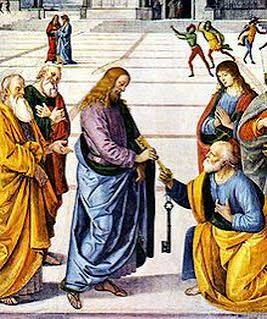
In the first reading from Isaiah, God removed Shebna, the unfaithful steward, and gave his office to Eliakim. God proclaimed that he would place the key of the House of David on Eliakim's shoulder and when he opens, no one shall shut, when he shuts, no one shall open. God demonstrated that He alone appoints and removes. Only God holds the master view of history. We return to the image of the key in the gospel passage when following Simon's profession of faith Jesus changed his name to Peter and gave him the keys to the kingdom of heaven. This is an extraordinary time in history. A simple fisherman was given the keys to heaven. the authority to bind and to loose, to open and to shut. The office once held by Eliakim is now fulfilled in Peter, the man, the flawed man, Jesus chose to entrust His Church on earth to. This authority did not die with Peter. It has been handed down, generation after generation, through the successors we know as the Popes. Peter was given the keys not because he was flawless, but because Jesus chose him. The Church rests not on the strength of humans but on the faithfulness of Jesus. This is demonstrated down the ages. Not every man appointed to the Chair of Saint Peter was a saint. There have been some dubious characters, and yet the Church endures. The Church is not built on the strength of men but on the promise of Jesus to remain with us, and the guidance of the Holy Spirit. The Church grows despite what weak men do, not because of it.
This is the Catholic Church, the universal Church, founded on Peter, guided by Scripture that is the inspired word of God, sustained by the teachings of Jesus and the living tradition handed on faithfully. Cutting this link between humanity and God, stepping away from the founding rock on which the Church is built causes drift and uncertainty. The more groups claiming to be Christian move away from this root, the more fragmented and thin the faith becomes. When a community forms simply because a teaching feels out of step with modern thinking, it risks cutting itself off from the very vine that gives it life. Fundamental truths cannot be discarded because they no longer suit the fashion of the day. It is vital that we stay united and cling to that foundation rock because the world tells us a different story. The world encourages us to be masters of our own lives, to see creation only from our own narrow perspective. God sees the whole picture, He knows how and why He made all things, and He sees each one of us, not as we see ourselves, not as others see us, but as He intended us to be and as we shall become in eternity.
The world goes astray when it tries to take God's place without understanding His purpose. We play at being god, we tamper with creation hoping to improve life, and there may be good in that, provided our aim is truly for the common good. The danger is that we can cross a line when we seek to become masters rather than stewards. We see it when countless human embryos are created only to be discarded. We see it in new laws that let us choose the hour and manner of our death. We do not own life, we are not the masters of creation, life is a gift to be lived according to the plan God has for us. This is why Saint Paul, in the second reading, tried to describe the depth of the riches, wisdom and knowledge of God. We cannot know the mind of God, we cannot give Him advice. God's judgments are beyond our understanding. The concluding words of the Eucharistic prayer are derived from the words of this letter, for from him and through him and for him are all things. All glory belongs to God alone. When we hear the words, through him, and with him, and in him, let us mean it. Let us surrender our limited view and trust His complete one. Let us hold fast to the authentic faith, remain united under Peter, and fix our hearts on attaining heaven.
We would do well to make the prayer found in the collect for today our own, O God, who cause the minds of the faithful to unite in a single purpose, grant your people to love what you command and to desire what you promise, that, amid the uncertainties of this world, our hearts may be fixed on that place where true gladness is found.
God Bless Brendan