Sunday the 29th of March 2026 - Palm Sunday
- Mar 28
- 5 min read
Matthew 21:1-11/ Isaiah 50:4-7/ Ps 22(21)/ Philippians 2:6-11/ Matthew 26:14-27:66
People today come to public notice for all sorts of reasons, politicians, athletes, celebrities, are subject to viral videos and become popular heroes overnight. Millions praise them, their images appear everywhere. Then, just as quickly, they can be demonised, rejected, the same people who praised them one day will decry them the next. Praise turns to hatred, the crowd demands the person be cancelled and destroyed. This general pattern of behaviour we often see today follows a pattern that is thousands of years old. Human nature loves to build people up, only to tear them down when they fail to meet earthly expectations.
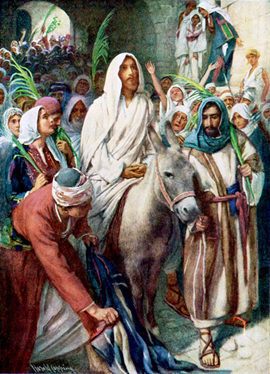
We see this pattern of behaviour in our readings today. We begin Mass holding palms, joining the crowd in shouting, "Hosanna in the highest" But it takes very little time for the joy of Palm Sunday to fade, and for that same crowd to start shouting, "Crucify him." We begin the holiest week of the year with a profound contrast. We recall the triumphant entry of Jesus into Jerusalem. The crowds hailed Jesus, waving palms and shouting praises. But Jesus rode humbly on a beast of burden, fulfilling the ancient prophecies. He did not come as a conquering earthly general, but as the humble Prince of Peace. We recall this moment at every Mass when we proclaim: "Hosanna in the highest. Blessed is he who comes in the name of the Lord."
The joy of Palm Sunday quickly faded. It took very little time for the crowds to be turned against Jesus, leading directly to His passion and death, which we also commemorate today. The world always seeks more power, more prestige, more validation. Jesus shows us a radically different way. Saint Paul offers a beautiful summary of this in his letter to the Philippians. Jesus humbled Himself, emptied Himself, and submitted to human death. He accepted the death of a despised criminal in total obedience to God the Father, all for the love of us. Jesus emptied Himself not by losing His divine nature, but by hiding His glory as one of us, a suffering human being. This profound humility is the ultimate antidote to human pride. Jesus showed his humility throughout the entire Passion narrative. It began at the Last Supper with the institution of the Eucharist, where He gave us His Body and Blood. Then, at Gethsemane, He showed us how prayer works. He knew the terrible torment that awaited Him. He prayed to His Father, asking that this cup of suffering might pass from Him. Yet, Jesus submitted totally to the will of God.
We might pray for something and feel unheard when something completely different happens. But if Jesus did not have His prayer answered in the way He asked, how can we expect otherwise? The important thing to remember is that all prayer is heard, and all prayer is answered. But God knows what we need rather than what we want. The two might be very different things. We do not see the totality of God’s plan for us, so we cannot always see what is best for us. Only God sees this.
As Jesus was taken in charge, all His followers fled. Even Peter, who said he would die with Jesus, could not stay awake one hour to pray with Him, later he denying even knowing Him. Jesus stood in front of the High Priest and remained silent as witnesses brought false testimony against Him. When Jesus finally spoke the truth to them, it was taken as blasphemy and led to the call for His death.
Jesus was then brought before the Roman governor, Pilate. Pilate had a duty to administer justice in his province and could see what was happening. He understood that an innocent man was being condemned by a crowd whipped up by their leaders. He tried to defuse the situation by offering to release Jesus instead of a known violent thug. When this did not work, Pilate gave in to fear. Fearing public disorder and his own standing with Rome, he washed his hands of the situation and handed Jesus over to be crucified. We see this trading of justice for popularity in our world today. How often are politicians driven by the loudest voices of the people rather than the truth of a situation? True justice comes from truth and integrity, not fear and weakness. The ethical principle that popularity does not equal truth should be a warning to us.
Jesus was then scourged, mocked as a king, dressed in purple, and crowned with a crown of thorns. He followed the suffering servant prophecies of Isaiah as He endured this pain. As He hung on the cross, quoting from the Psalms, Jesus cried out, "My God, my God, why have you forsaken me?" Jesus was not despairing, but praying in the person of His Body, the Church, giving a voice to our deepest human pain. At the death of Jesus, the first person to profess faith in Him was a Roman soldier who looked at the cross and proclaimed, "Truly this was the Son of God."
Today we are challenged to follow Jesus. We are called not just to follow Him to church, but in our daily lives. Can we trust Jesus even when the future looks frightening or confusing? We must have faith that God has a plan and is fully in charge. Part of that plan involves us serving Him faithfully until it is completed.
The Passion account today might seem familiar, but there is always something new we can take away from it. The Passion and death of Jesus presents the truth that we are sinners who have crucified Jesus. No matter how bad we might think our sins are, through His incredible gift, we can turn back to Jesus time and time again. We can always receive His mercy, especially through the sacrament of confession.
Today let us think about on which side of the crowd we stand. Do we live our lives shouting the acclamation, "Blessed is he who comes in the name of the Lord"? Or do our daily choices and actions shout, "Let him be crucified"? Let us consider the actions of Judas and Peter. Both men betrayed Jesus, but their responses to their sin were very different. We must not be like Judas, who betrayed Jesus and then failed to seek forgiveness, giving in to despair. Let us be like Peter. Though he also betrayed Jesus, he sought forgiveness and received the abundant mercy he needed.
We are called to take up our cross and follow Jesus; to trust in God’s plan and to go wherever it leads us. We find our strength in the hope that the Passion and death of Jesus gives us, when we recognise who Jesus is and exactly why He suffered for us.
At Mass Jesus, the self-emptying King becomes present to us in the Eucharist. He descends to hide His majesty under the humble appearance of bread and wine, offering Himself as our spiritual food. Let us enter this Holy Week with humble and contrite hearts, ready to walk with our King to the cross.
God Bless Brendan